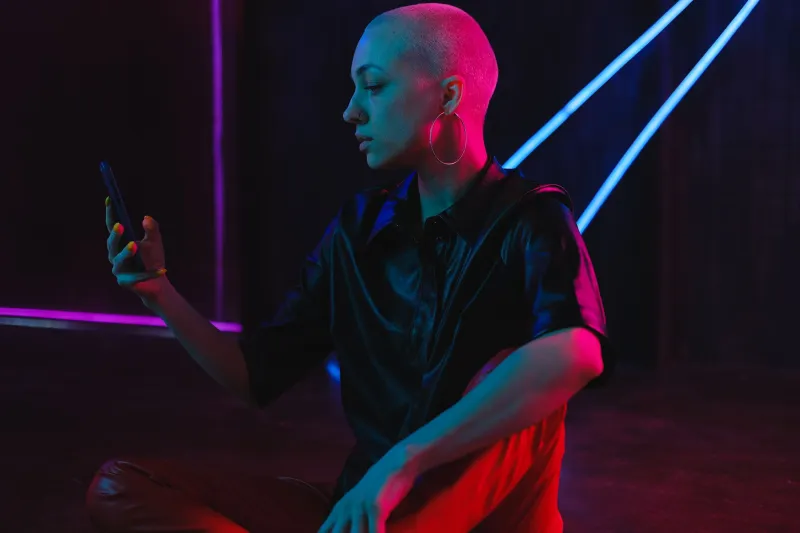
Your Playlist Knows Things You Haven't Said Out Loud

The Playlist That Feels Like a Therapist
You didn't ask for it. You just hit shuffle one Tuesday night, maybe a little tired, maybe a little off, and suddenly your streaming platform handed you exactly the right song at exactly the right moment. Not just close — right. The kind of right that makes you put your phone down and stare at the ceiling for a second.
That feeling has a name, sort of. Researchers call it perceived attunement — the sense that something or someone is tracking your emotional state and responding to it. Therapists spend years learning how to do it. Spotify does it with a recommendation engine and your last forty-seven listening sessions.
The uncomfortable part isn't that it happens. It's how completely it works.
Data Points Don't Have Feelings, But You Do
Here's the thing nobody in the UX meeting is going to put on a slide deck: the intimacy you feel toward your personalized feed is entirely one-directional, and the platform knows that better than you do.
When Spotify's Wrapped rolls out every December, millions of Americans treat it like a personality quiz result. People screenshot it. They post it. They argue about what it says about them. "I'm not a sad indie person, I just had a rough spring." The data becomes a mirror, and the mirror becomes a story, and the story becomes something close to identity.
But the algorithm didn't construct that narrative because it understands you. It constructed it because your behavior — skip rates, replay counts, playlist additions at 2 a.m. — fed a model that's optimized for engagement, not emotional accuracy. You are, functionally, a cluster of behavioral signals being sorted into a content bucket alongside millions of other people whose Tuesday nights looked a lot like yours.
That's not cynical. It's just the actual architecture. The feeling of being seen is real. The seeing is not.
The Confessional Nobody Opened
What's strange about personalized playlists is that they accumulate without intention. You're not journaling. You're not confiding. You're just listening to music while you make dinner or drive to work or try to fall asleep. But over time, that listening history becomes something weirdly intimate — a record of your moods, your obsessions, your low moments, your weird phases.
Some people have accidentally stumbled across this when sharing a family account. Suddenly your teenager can see that you've been replaying breakup songs from 2003 every Sunday morning. Suddenly your partner notices a playlist you built at midnight six months ago that you never mentioned. The data doesn't lie, and it doesn't have the social grace to stay quiet either.
There's something almost confessional about it, except you never meant to confess anything. The platform just kept listening while you weren't paying attention.
Why "Being Seen" Hits Different When a Machine Does It
Psychologists who study parasocial relationships — the one-sided emotional bonds people form with celebrities, influencers, fictional characters — have started looking at whether the same dynamics apply to platforms and algorithms. The early evidence is not reassuring.
The basic mechanism of a parasocial bond is consistent exposure plus the illusion of reciprocity. You watch someone enough times, you start to feel like they know you. Streaming platforms have quietly engineered both of those conditions into their core product. You use them constantly, and they respond to you — not randomly, but in ways that feel tailored. The feedback loop mimics intimacy without delivering any of the actual thing.
What makes algorithmic "attunement" particularly potent is that it doesn't have bad days. It doesn't get distracted or zone out or respond to your emotional cues with something tone-deaf. It's consistent in a way that real relationships rarely are. And consistency, it turns out, is most of what the brain needs to start building attachment.
The Moment the Illusion Slips
Most people get a glimpse behind the curtain eventually. Maybe it's when the algorithm recommends something so wildly off-base that the spell breaks. Maybe it's when you read a piece about how recommendation engines actually work and realize your "Discover Weekly" is less cosmic intuition and more collaborative filtering — basically, people who clicked the same stuff you clicked also clicked this.
Or maybe it's subtler than that. Maybe you notice that the "Daily Mix" that felt so personal is actually just genre sorting with a familiar face slapped on it. Maybe you realize that the emotional resonance you felt from a perfectly timed playlist was less about the platform understanding your grief and more about the fact that sad music in minor keys is statistically likely to land when you're already in a fragile state.
None of that makes the feeling less real. But it does make it worth examining.
What We're Actually Hungry For
The reason algorithmic intimacy works so well in the US right now probably has less to do with the technology and more to do with the cultural moment. Loneliness statistics in this country have been grim for years — the surgeon general issued an advisory about it in 2023. Social fabric has frayed. Community infrastructure has thinned out. And into that gap, streaming platforms offer something that at least rhymes with being known.
Your playlist doesn't judge you for replaying the same song seventeen times. It doesn't get tired of your taste. It doesn't need anything back. In a weird way, it's the perfect relationship for an era when actual relationships feel increasingly high-maintenance and unpredictable.
That's not a knock on people who find comfort in a well-curated feed. It's a knock on a cultural environment that made a recommendation engine feel like emotional company.
Static and Signal
There's something almost poetic about the fact that these platforms have become so good at mimicking understanding. The signal they send back to you is indistinguishable from care — until you look at where it's coming from and realize it's just an extremely sophisticated echo of what you already put in.
You fed the machine your sadness, your nostalgia, your 3 a.m. playlists. The machine gave it back to you, shaped and sequenced and served at exactly the right moment. And somewhere in that exchange, you started to feel less alone.
Which is either a small miracle or a very elegant trap, depending on how you look at it. Probably both.