Ghosts With Good PR: The Uncomfortable Business of Resurrecting Dead Celebrities With AI
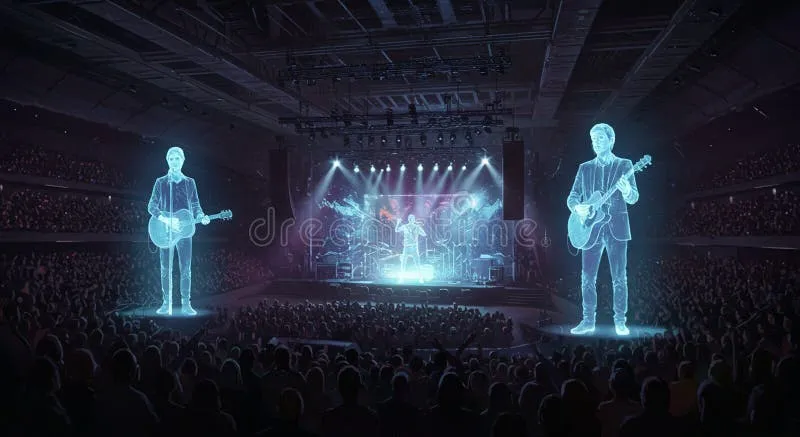
Photo: hologram concert stage performer spotlight dark arena, via thumbs.dreamstime.com
There's a specific kind of wrong that settles in your chest when you watch a dead person move. Not the theatrical wrong of a horror movie—something quieter. Something that sits behind your sternum and hums.
We've been living with that hum for a while now. The Tupac hologram at Coachella 2012 was supposed to be a moment of awe. And it was, briefly. Then the crowd went a little too wild, and the cameras pulled back, and you could see the projection seams, and suddenly what felt like magic felt like a ventriloquist act with a very famous dummy. Nobody said it out loud at the time. But they felt it.
Now the technology has gotten so much better. And the feeling has gotten so much worse.
The Valley Gets Deeper
Most people have heard of the uncanny valley—the concept borrowed from robotics that describes the creeping discomfort we feel when something almost-human gets too close to human without quite making it. The theory has been applied to CGI characters, to realistic dolls, to certain types of social media filters. But the AI recreation of deceased celebrities lands somewhere different. Somewhere the original concept didn't anticipate.
Because it's not just about realism. It's about identity.
When you watch a deepfake of, say, a young James Dean promoting a car he never drove in a commercial released decades after his death—which actually happened in 2021—you're not just watching a digital puppet. You're watching a version of a real person, a person with a documented inner life and documented opinions, being animated by a machine that knows nothing about either. The body is there. The soul is a simulation.
Digital ethicist Bettany Morse, who consults for several media organizations on synthetic media policy, put it plainly in a recent conversation: "The uncanny valley for AI celebrity recreation isn't about the face. It's about consent. We have an evolved sensitivity to when someone is being used. And something in us recognizes that the person on screen didn't agree to this."
The Fan Side of the Equation
Here's where it gets complicated, because not everyone feels that discomfort. Or at least, not everyone feels only that discomfort.
Fan communities built around deceased artists have been among the most vocal and divided audiences for AI recreation projects. On Reddit forums dedicated to Elvis Presley, the debate over AI-generated vocals—new "recordings" stitched together from archival material—splits almost cleanly along generational lines. Older fans who saw Elvis perform tend to find the reconstructions hollow at best, offensive at worst. Younger fans who came to Elvis through streaming and documentaries are often more open to it.
"It's the only way I'll ever hear something new from him," one user posted in a thread on r/Elvis that drew hundreds of responses. "I know it's not real. I'm not stupid. But it scratches a real itch."
That itch is worth taking seriously. Grief doesn't follow logical rules. The desire to spend more time with someone you've lost—even a parasocial someone, a celebrity you never met but whose work shaped how you understood the world—is a genuinely human impulse. The platforms and production companies that traffic in AI celebrity resurrection aren't inventing that desire. They're monetizing something that already existed.
Which is, of course, exactly the problem.
Who Owns the Dead?
The legal landscape around posthumous likeness rights is a patchwork. In the US, protections vary wildly by state. California offers some of the strongest statutes, extending personality rights for up to 70 years after death. Other states have almost nothing on the books. And none of the existing frameworks were written with generative AI in mind.
Estates—the people who legally control a deceased celebrity's image and likeness—hold enormous power here. Some have been protective. The estates of certain artists have flatly refused to license likeness rights for AI projects. Others have leaned in hard. The estate of a beloved Motown artist recently partnered with a tech startup to release what they called an "AI tribute experience." The backlash was swift. The defense was that the family approved it.
But family approval doesn't resolve the deeper question: what did the artist want? What would they have consented to? We can't know. The dead can't update their preferences. And that silence gets filled—by estates, by corporations, by fan consensus—in ways that may have nothing to do with who the person actually was.
The Impersonator Comparison Falls Apart
Some people argue this is just the digital version of a tribute band or an impersonator act. Elvis impersonators have been a cottage industry for decades. Nobody clutches their pearls about a Vegas performer doing "Suspicious Minds" in a white jumpsuit.
But the comparison breaks down fast. An impersonator is a human being doing an impression. The performance is framed as imitation. The gap between the performer and the subject is visible and understood. Nobody walks out of an Elvis tribute show thinking they encountered Elvis.
AI recreation is designed specifically to collapse that gap. The entire point is to make the seams disappear. And when the seams disappear, so does the frame that kept everything safe and clearly labeled as homage.
There's also the scale problem. An impersonator performs for a few hundred people in a room. An AI-generated video clip can be served to fifty million people in a week. The reach changes the stakes.
What We're Actually Looking For
Maybe the most honest thing to say is that AI celebrity resurrection tells us more about the living than the dead. The demand for these products is a demand for continuity—for the feeling that the cultural figures who mattered to us don't fully leave. That's not pathological. That's just grief, running up against its own limits and looking for a workaround.
The technology will keep improving. The recreations will get more convincing. The discomfort probably won't go away, because it isn't rooted in technical imperfection. It's rooted in something more fundamental: the sense that we're watching a door that should stay closed get forced open, over and over, for an audience that can't stop watching.
The signal is clear. We're just not sure we like what it's saying.