The Algorithm Already Knew: When Your Feed Starts Feeling Like a Mirror You Didn't Sit In Front Of

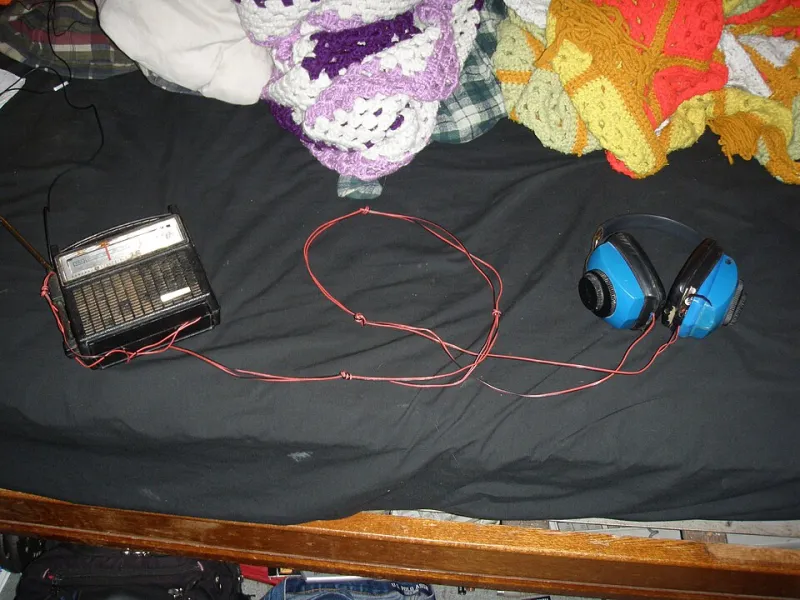
Photo: PattayaPatrol, CC BY-SA 4.0, via Wikimedia Commons
Let's start with a story you've probably lived.
You're going through something. Not anything you've posted about, not anything you've searched for—just a feeling, the kind that exists in the background of a regular Tuesday. You open a streaming app without any particular intention and the first thing it serves you is a song that lands so precisely in the center of that feeling that you have to set your phone down for a second.
You didn't ask for it. You didn't look for it. It was just there, waiting.
The rational explanation is always available: behavioral data, collaborative filtering, the accumulated weight of your listening history pointing toward a predictable next step. The algorithm didn't know anything. It made a probabilistic guess based on patterns. You can say all of that and still feel, somewhere below the rational explanation, like something was watching.
The New Divination
Humans have always wanted to believe that something out there knows the shape of their interior life. Astrology. Tarot. The I Ching. These systems persist not because people are irrational but because the desire for external reflection of internal experience is basically hardwired. We want confirmation that what we're feeling is real and legible—that it has a shape that can be read.
Recommendation algorithms have slipped into that psychological slot without anyone really announcing it. They didn't mean to. They were built to maximize engagement and reduce churn. But the byproduct of that optimization is a system that sometimes performs an eerie kind of knowing—one that feels less like a machine making a guess and more like something that has been paying attention.
Data researcher and writer Caleb Osei, who has spent several years studying how people anthropomorphize digital systems, describes it this way: "The algorithm isn't conscious. But it's built from the aggregate behavior of millions of people who share your situation. When it recommends something that fits your life perfectly, it's because a lot of people in your exact emotional position clicked on that same thing. You're not being seen by a machine. You're being seen by a crowd that doesn't know it's watching you."
That framing should be reassuring. Somehow it isn't.
The Timing Problem
The frequency of these moments is what makes them hard to dismiss. One uncanny recommendation is a coincidence. A steady stream of them starts to feel like a pattern—and human brains are extremely good at detecting patterns, even when those patterns are partly constructed by the brain doing the detecting.
But people keep reporting experiences that go beyond ordinary predictive accuracy. A woman in Portland described opening Netflix the week her father was diagnosed with a serious illness and finding a documentary about end-of-life care in the top row of her recommendations. She hadn't searched for anything related to illness. She hadn't discussed it in any app. "I hadn't even told most of my friends yet," she said. "The app knew before my friends did."
The rational explanation, again, is available. Recommendation systems pull from enormous datasets. They track not just what you watch but when you watch it, how long you linger on thumbnails, whether your usage patterns have shifted. A change in how someone uses a platform—watching more slowly, returning to older content, opening an app in the middle of the night—creates a signal. The system doesn't know what's happening in your life. It knows that your behavior has changed in ways that correlate with certain content categories.
But here's the thing: that explanation is almost more unsettling than the supernatural one. The algorithm doesn't need to read your mind. It reads your behavior, and your behavior leaks everything.
What Gets Surfaced and When
There's a category of recommendation story that keeps coming up in conversations about this stuff: the hyper-specific niche hit. Not the emotional resonance angle, but the precision angle. You've been idly curious about, say, the history of a very specific architectural style in a specific city, a topic you've never searched for directly but have approached obliquely through three or four unrelated videos. And then it appears—a 45-minute documentary that is exactly that, from a channel you've never heard of with 800 subscribers.
This one is easier to explain technically. It's also the one that most reliably makes people feel like the platform has been eavesdropping on their thought process rather than their clicks.
The gap between "this makes sense given my data" and "this feels like surveillance" has been collapsing for years. And the platforms have not been particularly eager to help people understand which side of that line they're on. Opacity is a feature, not a bug—if users understood exactly how recommendations were generated, the system would lose some of its persuasive magic.
The Ghost in the Recommendation Engine
There's a version of this conversation that's purely about data privacy—about what's being collected, by whom, and what it's being used for. That conversation is important and not happening enough at the policy level. But there's another layer underneath it that's more about psychology than politics.
We are building digital selves that are, in some measurable ways, more legible than our actual selves. The behavioral data that accumulates across platforms knows things about us that we haven't consciously acknowledged. It knows what we return to when we're anxious. It knows what kind of content we consume after a fight with someone we love. It knows the shape of our attention at 2am.
When the algorithm surfaces something that fits that shape perfectly, we're not encountering something alien. We're encountering a reflection—a version of ourselves that was assembled from our own exhaust without our participation.
That's not a ghost. But it's not nothing, either.
Somewhere in the static between "this is just math" and "something knows me," there's a feeling that doesn't fully resolve. Pecigie readers probably know it well. It's the same feeling you get when you find a signal in the noise—the suspicion that the noise was arranged.
Maybe it was. Maybe the arrangement is just you.